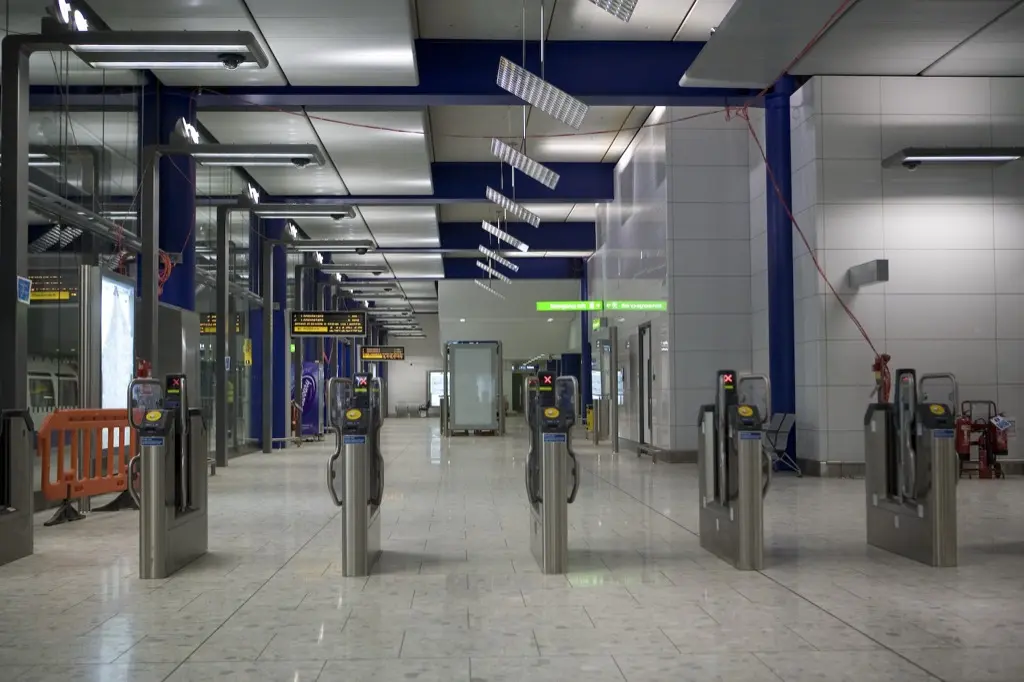
Your plane has landed, your bag is off the belt, and the next train leaves in 11 minutes. Welcome to the hardest part of the trip.
What goes wrong — and why it costs you £70
Heathrow Terminal 5 is modern, well-signposted, and still manages to route a steady stream of first-time visitors directly into the taxi queue. Here's what happens: you exit baggage reclaim, follow the flow of other passengers out of the building, and find yourself at the rank before you've registered that the Underground entrance was back inside. A black cab to central London: £70–£90. The Piccadilly line: £5,90. The difference is one wrong turn.
The problem isn't poor signage — it's decision fatigue. After a long flight, you follow people rather than signs. And the people nearest the exit are often heading for a taxi.
What you need to know before you reach the barriers
The arrivals hall is not the station — finding your platform costs minutes you don't have
Airport train stations sit anywhere from 50 metres to a 10-minute walk from the baggage carousel. At Paris CDG, the RER B station is a covered walkway and shuttle bus away from Terminal 2. At Heathrow T5, the Elizabeth line is a short walk inside the terminal — but you need to know that before you walk out. Look up where the station entrance is before your bag comes off the belt.
Buying a ticket at the machine takes longer than you think
A busy airport ticket machine queue can cost you 10–15 minutes. Interfaces switch between languages, screen glare is brutal, and there are always three people in front of you who've never used one. The fix isn't patience — it's arriving with your payment method already set up. A contactless bank card or a pre-loaded transit app skips the machine entirely at most European airports.
Your mobile data probably won't work the moment you land
Roaming activates, but it's not instant. Between landing and leaving the terminal, you have a 5–15 minute window where Google Maps won't load and you can't pull up your booking confirmation. This is exactly when you need it. Download your route offline (Google Maps, Citymapper, or Maps.me all support this) before the plane descends.
Your luggage may not fit — especially at rush hour
European airport trains are commuter trains. On the Piccadilly line at 08:30, a standard suitcase takes up the space of two standing passengers. If you land during peak hours (07:00–09:30 or 17:00–19:30), take the next train rather than forcing your way on — a 15-minute wait is cheaper than a damaged bag or a missed stop.
Five steps from the gate to your hotel stop
- Before descent: download your route offline. Open Citymapper or Google Maps, search your airport → hotel route, and save it for offline use. Do this while you still have in-flight Wi-Fi or before you switch off data.
- At baggage reclaim: screenshot the full address of your hotel. Not just "Paddington" — the exact street address and postcode. Some cities have multiple stations with similar names.
- Before you exit the terminal: find the transit entrance inside the building. Don't follow the crowd out. Look for Underground, Metro, RER, or S-Bahn signs and follow those. The taxi rank is almost always in the same direction as the exit; the train usually isn't.
- At the barrier: have your payment ready before you join the queue. Contactless card or phone out, transit app open if needed. Don't reach the front of the queue and then start digging through your bag.
- On the platform: confirm your direction. Every major European airport train has two directions. Check the final destination on the train display matches your route — not just the line name or colour.
How it compares: three airports, three approaches
| City | Train from airport | Journey time | Tip for your first 15 minutes |
|---|---|---|---|
| London (Heathrow) | Elizabeth line | ~35 min to Paddington | Touch in with your contactless card — no separate ticket needed; fare counts toward your London daily cap |
| Paris (CDG) | RER B | ~35 min to Gare du Nord | Buy your ticket at the machine before joining the platform queue; all CDG machines have English |
| Barcelona (T1/T2) | Aerobús | ~35 min to Plaça Catalunya | Board at the clearly signed stop outside arrivals — driver accepts contactless, no change needed |
Common mistake
The official airport transfer service — train, metro, RER — sometimes looks more expensive than an app-based taxi when you compare prices in the arrivals hall. It isn't: the cheaper option usually gains an "airport supplement", "booking fee", or surge pricing by the time you reach checkout. Take the train.
Roamy's quick checklist
- Download your airport → hotel route offline before the plane lands
- Screenshot your hotel's full address and postcode
- Find the transit entrance inside the terminal before you exit the building
- Have your contactless card or transit app ready before you reach the barrier
- Check the final destination on the platform display — not just the line colour
Going deeper on a specific city? The London transport guide covers Tube zones, Oyster vs contactless, and the Elizabeth line in detail. The Paris transport guide breaks down RER, Metro, and CDG airport options zone by zone.
Already planning your London trip? London public transport for tourists 2026: Oyster vs contactless covers Heathrow fares, daily caps, and the one case where families still need an Oyster card. The Paris equivalent — covering Metro tickets, zones, and CDG options — is coming in article 4 of this series.